
Next close in
--:--
- Close
- -
- Closes today
- -
- Block height
- reading
- Blocks
- -
- Gas price
- reading
Block height straight from the RPC. Watch it move.
Pre-launch · Robinhood Chain
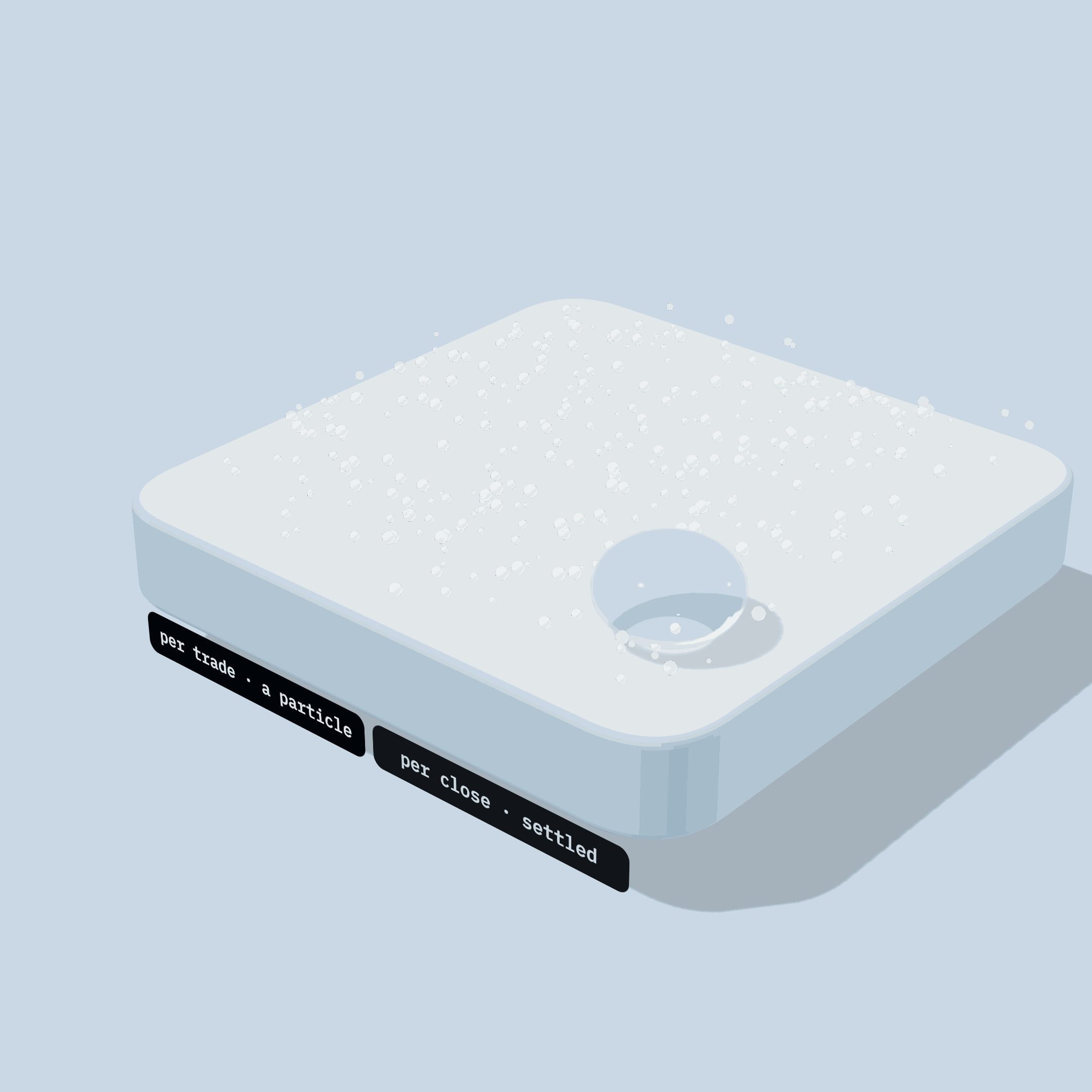
Every trade of $mist leaves a particle of fee, too fine to notice on its own. Every ten minutes the engine gathers the particles, buys $mist with them, and settles it into every wallet that holds it, whatever its size. Nothing to stake. Nothing to claim. The longer you hold, the bigger your share of every close, up to a ceiling the community raises. The index is mist settled per million since genesis.
issuance pending
Published here and on X in the same minute, written into the page source rather than injected by a script. If the two ever differ, one of them is a forgery.
The machine
Closes land every ten minutes, 144 times a day, aligned to UTC midnight, from a genesis of 2026-09-12 00:00 UTC. The countdown and the close number come from those frozen parameters. The block height comes from Robinhood Chain, live, in your browser. The fee in the strip above is the venue's own terms, read on chain off the pons.family curve the engine replayed: 100 bps to the venue and about 370 bps of creator take. Once the token exists, the index and the receipts come from the engine.
Next close in
--:--
Block height straight from the RPC. Watch it move.
Index
0.00000
Nothing has settled yet: the first mist gathers on the first trade. The index counts mist settled per token since genesis, so it starts at zero rather than at one. It is the average across every wallet; what any one wallet receives depends on its own hold weight.
Settle calculator
0 mist
Arithmetic on the rules. The mist lines wait for the venue to state its fee rate; the figure above them is the cistern floor across a day, which holds whether or not anyone trades. Every wallet is paid at its own weight whatever its size, so this works the same at any holding you type. The weighted share assumes every other wallet sitting at 1.00x, which is the one assumption a browser can defend; in a field that has held as long as you have, it comes back toward your flat share.
Wallet
no wallet found
Mist settles into this wallet on its own. There is no button here that moves a token, because mist has no such button anywhere.
Your browser reads the block height, the gas price and the client string from the Robinhood Chain RPC. The wallet card connects over EIP-1193 and reads balances with eth_call. The countdown, the close number and the calculator are arithmetic on the parameters printed above, so they cannot drift from the numbers the engine ships with.
This page never signs anything. There is no stake path in mist to sign for: holding the token is the whole action. app.js carries no signing method and no ERC-20 write selector, and nothing loads one later. Fetch it and grep it.
The engine wallet holds gathered mist for at most one close. Every settlement is a transfer you can read on the explorer, against an address published on this page. The engine's decisions are logged and published, so you can check what it did against what it said it would do.
How it settles
No whitelist, no allocation form, no role to farm, and nothing to sign after the buy. The mist finds any wallet you control.
Launches on pons.family, then routes to Uniswap. Any size, no gate. The contract address lands here and on X in the same minute.
Any wallet you hold the keys to. Exchange accounts and pool positions do not receive mist, because the snapshot excludes them.
Every ten minutes the mist gathered since the last close settles into your balance. No transaction from you, no button, no claim.
Optional. Sell ETH or USDC to the treasury and take $mist back below market, vested over five days. Bonds are the only way reserves enter the cistern.
Receipts
Every close prints a receipt: the close number, the minute it landed, how many trades breathed, how much mist gathered, how much settled per million $mist, and the index after. Until the token exists these lines come from the rules and say so. From launch they come from the engine.
| Close | Closed | Trades | Mist gathered | Settled per million | Index after | Avg weight | Ceiling |
|---|
Mechanism
All six sit on chain and all six are boring on purpose. The only idea is that the fee the chart already pays goes back to the wallets that held through it.
Every trade of $mist pays the venue fee, the same fee the venue already charges. That fee is one particle of mist. On its own it is too fine to notice.
Between closes the particles accumulate in the engine wallet. That wallet is published, on chain, and its balance is readable by anyone at any moment.
Every ten minutes the engine swaps the gathered mist to $mist with a minimum out and a deadline, so a thin book cannot turn a close into a donation.
The $mist goes to every wallet that holds it at the snapshot, pro rata by balance times hold weight. Every wallet is paid at its own weight, whatever its size. The curve, the pool, the engine, the treasury and the locked supply are excluded. Dust below one $mist rolls into the next close.
While the air is still, the mist reserve pays a floor of 0.005% of circulating per close, until it is spent. When trade mist clears the floor, the floor is not paid.
Sellers leave the room and the mist stays on the ones who stayed. The maths is old. Coordinating people is the hard part, so mist pays for it 144 times a day.
Holder rewards
Every wallet is paid for holding, whatever its size, and its share of a close is its balance times its hold weight. The weight starts at 1.00x on your first close and climbs in a straight line to the ceiling over 24 hours of unbroken holding. The ceiling starts at 3.00x and the community raises it: every 250 holding wallets adds 0.50x, to 5.00x at 1,000.
Hold weight over 24 hours of unbroken holding
Two wallets, the same balance. One holds through every close and reaches the ceiling. One sends $mist out partway and starts again at 1.00x. Neither is punished; the second simply stops being an unbroken hold.
The ceiling
| Holding wallets | Ceiling |
|---|
The threshold decides the ceiling, never who gets paid. A holding wallet, the unit this table counts, is one that held at least 10,000 $mist through a close. Every wallet is paid at its own weight whatever its size; a smaller one simply does not count toward raising the ceiling. The ceiling never falls: when wallets leave it holds at the highest level the community reached.
where every wallet starts
the ceiling, reached in 144 closes
the highest the ceiling goes
Caveat. A weight changes who gets each close's mist, never how much mist there is. The pot is whatever the fee gathered since the last close; a bigger weight is a bigger share of that pot, not a bigger pot. If every wallet reached the ceiling on the same close, every share would be exactly what it is today.
The settle
There is no claim button because there is nothing to claim. Mist is not sent to you on request. It is added to what you already hold, 144 times a day, whether or not you are watching.
Settled per million over a day of closes
Straight while the air is still, because the cistern pays the same floor at every close. Trade mist rides on top of it and moves with the chart, so the real line is never smoother than the volume that made it.
the cistern floor, of circulating
the floor across 144 closes
paid until the cistern is spent
whatever the fee gathers, read at every close
the floor compounded, if the cistern lasted a year and no trade mist arrived. It is a floor, not a promise, and the cistern is finite.
Caveat. Token count, not price. The floor comes out of a finite reserve and stops when that reserve is spent. Trade mist depends entirely on how much anyone trades, which is nobody's to promise. The value of the token can fall for every ordinary reason a token's value falls, and nothing on this page protects against that.
Chain
An Arbitrum Orbit rollup running the nitro client, gas paid in ETH. The client string and the block height in this card come from the RPC, not from a deck. $mist launches on pons.family and routes to Uniswap from there.
$mist
Supply at genesis
1,000,000,000
$mist on Robinhood Chain. No presale, no private round, no tax on buys or sells beyond the venue's own fee. The token is issued by the launchpad with no mint function, so the supply is fixed at issuance. What settles into wallets is $mist bought on the open market with the fee the chart already paid.
Open pool on pons.family at launch, then Uniswap
58%
The cistern. Pays the floor at every close so day one settles even when nobody trades
15%
The first layer of backing. Bonds fill it from there
10%
12 month linear vest, nothing unlocked at launch
12%
Integrations, audit, market making
5%
Changelog
Parameters frozen: ten minute close, 144 a day, the cistern floor at 0.005% of circulating per close, one billion at genesis
step 01Genesis clock started, 2026-09-12 00:00 UTC. The engine inherits this schedule
step 02This site: live chain reads, wallet reads, the settle calculator, receipts. Read only, and it stays that way
step 03Engine written and running in paper mode over real trades, blind verified. Not deployed against a live token
step 04Launch on pons.family. Contract address published here and on X in the same minute
step 05Engine wallet published and the first close settled
step 06Receipts posting to X at every close, rolled up hourly
step 07Holder Rewards: hold weight and the community ceiling, frozen
step 08Bonds open, the treasury starts filling, backing per token published
step 09Routing to Uniswap
step 10The engine posts its own receipts
The shape of a close. The figures here are what the rules produce with no trades in the window. The fields only the engine can fill are the ones that wait for a token.
FAQ
A rebase that happens in your wallet. You buy $mist and you hold it. Every ten minutes the engine takes the fees that every trade of $mist has paid since the last close, buys $mist with them, and sends that $mist to every wallet that holds it, in proportion to what it holds times how long it has held. Your balance grows where it sits.
The venue fee on every trade, which the chart already pays and which normally goes to the creator. Here it is gathered and handed back to the wallets that held through the trade. On top of that the mist reserve pays a floor at every close while the chart is quiet. Nothing is minted; every token that settles was bought on the open market.
No. There is nothing to stake, nothing to lock and nothing to claim. There is no second token and no receipt token. Hold $mist in a wallet you control and the settlement arrives as an ordinary transfer, with no transaction from you.
Because nothing has settled yet. The index counts mist settled per token since genesis, so before the first trade it is zero and the page shows zero. A classic rebase index starts at one; this one starts at nothing, which is the honest number until the first close pays.
The block height, the gas price and the client string come from the Robinhood Chain RPC in your browser. The clock, the close number and the calculator are arithmetic on the parameters printed on the page. Once the engine runs, the index and the receipts come from its feed and the page says which one you are looking at.
No, and you do not have to take that on trust. Connecting asks for account access and reads balances, which is all it does. Fetch app.js and search it for an ERC-20 write selector or any signing method. There are none, and unlike a staking site there is no second file that loads one later, because mist has no action for you to sign.
Any wallet you hold the keys to. The snapshot at each close excludes the bonding curve, the liquidity pool, the engine wallet, the treasury and the locked supply. Tokens sitting on an exchange are held by the exchange, so the mist goes to the exchange's wallet and not to you. Hold it yourself.
Still air is not zero. The mist reserve pays a floor of 0.005% of circulating at every close, so a quiet day still settles. The floor is finite: it comes out of a reserve of fifteen percent of supply and it stops when that reserve is spent. When trade mist clears the floor, the floor is not paid.
No. Mist runs independently and holds no affiliation with either. Fee redistribution is a public idea and people have implemented it many times. This is a new implementation of it, on a clock, on a new chain.
Your share of a close is your balance times your hold weight. The weight is 1.00x on your first close and climbs in a straight line to the ceiling over 24 hours of unbroken holding, which is 144 closes. At twelve hours you are halfway up the line. Nothing is registered and nothing is locked: the engine reads how long you have held from the chain's own transfer history.
Any outgoing transfer of $mist from your wallet puts you back at 1.00x. Buying more does not: the position is averaged by balance, so a small early hold cannot buy a large late one a head start. Sending a single token out is a reset, so if you want the weight, leave the balance where it is.
A wallet that held at least 10,000 $mist through a close. It is a counting unit for the ceiling and nothing else. Every wallet is paid for holding at its own weight whatever its size, so a wallet under the threshold earns exactly as it would otherwise; it just does not count toward raising the ceiling. The engine prints the count on every receipt so anyone can check it against the chain. The curve, the pool, the engine wallet, the treasury and the locked supply are excluded from both.
Every 250 holding wallets adds 0.50x to the ceiling, from 3.00x at genesis to 5.00x at 1,000. It never falls. If wallets leave, the ceiling holds at the highest level the community reached, and when it rises every wallet keeps climbing toward the new one on the same line. Nothing resets.
No. Nothing leaves your wallet, nothing is locked, there is no deposit and no contract holds your tokens. The record is the chain's own transfer history, which exists whether or not mist reads it. You cannot be locked out of a token you never handed over, and there is no unstake to queue for.
Watch the clock for a few minutes before you decide anything. It is counting real closes, right now, on the schedule the engine inherits.
contractissuance pending